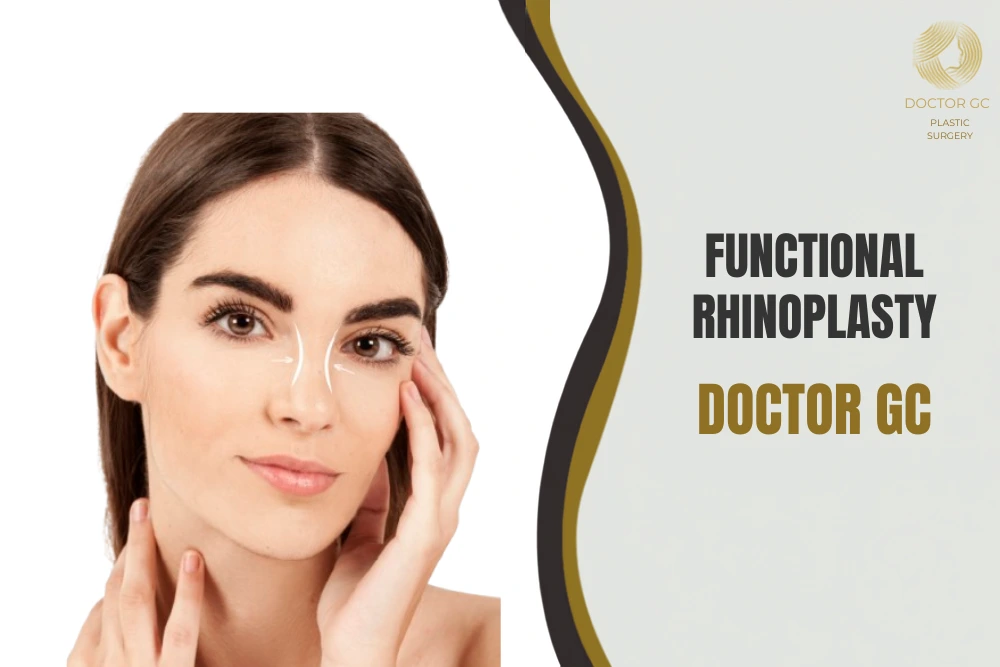
If you’ve been told you need “nose surgery” but the conversation has nothing to do with how your nose looks, you’re probably looking at functional rhinoplasty. Most people hear “rhinoplasty” and think cosmetic — reshaping a bump, narrowing a tip, refining a profile. But a large share of rhinoplasty procedures are performed for a completely different reason: to fix a nose that doesn’t work properly, even if it looks perfectly fine from the outside.
Functional rhinoplasty is the surgical correction of structural problems inside the nose that restrict airflow. It’s the procedure behind chronic nasal congestion that won’t respond to medication, snoring that started after a nose injury, or a lifetime of breathing through your mouth because one nostril has never really worked. If any of that sounds familiar, here’s what functional rhinoplasty actually involves, how it differs from the cosmetic version, and what to expect if you’re considering it in Delhi.
What Is Functional Rhinoplasty?
Functional rhinoplasty is a surgical procedure that corrects structural abnormalities inside the nose to restore normal airflow and breathing. Unlike cosmetic rhinoplasty, which focuses on the external appearance of the nose, functional rhinoplasty addresses what’s happening beneath the surface — the cartilage, bone, and soft tissue structures that determine how air actually moves through your nasal passages.
Common structural issues that functional rhinoplasty corrects include:
- Deviated septum — the wall of cartilage and bone between the nostrils is off-center, restricting airflow on one or both sides
- Nasal valve collapse — the internal or external nasal valve narrows or collapses inward during breathing, especially during exertion
- Turbinate hypertrophy — enlarged turbinates (the ridges inside the nose that humidify air) block the nasal passage
- Post-traumatic nasal obstruction — an old injury, even one that healed years ago, that left the internal nasal structure misaligned
- Congenital nasal narrowing — structural airflow restriction present from birth
Signs You Might Need Functional Rhinoplasty
Not everyone with a stuffy nose needs surgery. But certain patterns point to a structural problem rather than a temporary or allergy-related one:
- Chronic difficulty breathing through one or both nostrils that doesn’t improve with medication
- Snoring or sleep-disrupted breathing that developed after a nasal injury
- A history of nasal trauma (a broken nose, even an old one)
- Nostrils that visibly collapse or pinch inward when you inhale deeply, especially during exercise
- One nostril that has always felt more blocked than the other, regardless of allergies or colds
- Frequent sinus infections linked to poor nasal drainage
If several of these apply to you, a consultation with a plastic surgeon experienced in nasal airway surgery is worth pursuing — home remedies and nasal sprays generally can’t fix a structural problem.
Functional vs. Cosmetic Rhinoplasty: What’s the Difference?
| Aspect | Functional Rhinoplasty | Cosmetic Rhinoplasty |
|---|---|---|
| Primary goal | Restore normal airflow and breathing | Improve the external shape and appearance |
| What it addresses | Deviated septum, valve collapse, turbinate issues | Nasal hump, wide bridge, drooping or bulbous tip, asymmetry |
| Visible external change | Often minimal or none | Central to the procedure |
| Insurance coverage | Sometimes partially covered, since it’s medically necessary | Typically not covered |
| Can be combined? | Yes — this combination is called septorhinoplasty | Yes — same combined approach |
| Recovery focus | Improved breathing within weeks | Final cosmetic shape settles over months |
In practice, the line between the two isn’t always sharp. A patient with a deviated septum from an old injury often also has some visible asymmetry, and many people choose to correct both the function and the appearance in a single surgery. That combined procedure — improving airflow and refining the shape at the same time — is called septorhinoplasty, and it’s one of the more common reasons patients seek out Rhinoplasty Surgery in Delhi in the first place.
How Functional Rhinoplasty Is Performed?
The procedure is typically performed under local or general anesthesia, depending on the complexity of the correction and whether it’s combined with cosmetic work.
Assessment and planning: Before surgery, the surgeon evaluates the internal nasal structure — often with a nasal endoscopy — to pinpoint exactly where airflow is restricted. This might reveal a deviated septum, a collapsed nasal valve, enlarged turbinates, or a combination of these.
Septal correction: If the septum is deviated, the surgeon repositions or trims the cartilage and bone to straighten it, a procedure that on its own is called septoplasty.
Valve reconstruction: For nasal valve collapse, cartilage grafts (often taken from the septum itself) are used to reinforce the weakened area and prevent it from collapsing inward during breathing.
Turbinate reduction: Enlarged turbinates can be reduced in size to open up the airway without removing them entirely, since they play a role in humidifying and filtering the air you breathe.
Closure: Once the structural work is complete, incisions are closed — usually inside the nose, leaving no visible external scarring, unless the procedure is combined with an open cosmetic approach.
Recovery After Functional Rhinoplasty
Recovery generally mirrors that of standard rhinoplasty, though most patients notice a breathing improvement more quickly than they’d notice a cosmetic change:
Week 1: Mild swelling, congestion, and bruising are expected. A splint or internal packing may be used to support the new structure. Breathing may temporarily feel more restricted due to post-surgical swelling, not the surgery failing.
Week 2–3: Splints are removed, and most patients start noticing clearer airflow, even as residual swelling continues to resolve.
Month 1–3: Breathing typically stabilizes at its improved baseline once internal swelling has fully subsided.
Long-term: Results are generally permanent, since the structural correction — not just swelling reduction — is what restores the airway.
Cost of Functional Rhinoplasty in Delhi
Functional rhinoplasty costs are typically assessed separately from cosmetic rhinoplasty, since the surgical complexity depends on which structures need correction — septum alone, valve reconstruction, turbinate reduction, or a combination. Costs also vary based on whether the procedure is purely functional or combined with cosmetic reshaping (septorhinoplasty). For a full breakdown of pricing across all rhinoplasty types, see our detailed guide to rhinoplasty surgery cost in delhi.
Why Choose Dr. Gautam Chaudhury for Functional Rhinoplasty
Correcting the internal structure of the nose without compromising its appearance — or, where desired, improving both together — requires precision and a clear understanding of nasal anatomy. Dr. Gautam Chaudhury brings over 16 years of experience in plastic and reconstructive surgery, including nasal airway correction, to every functional rhinoplasty consultation. Patients researching the Best Cosmetic Surgeon in Delhi for either functional or combined septorhinoplasty procedures can expect a detailed pre-surgical airway assessment, a customized surgical plan, and natural-looking results when cosmetic correction is included.
Frequently Asked Questions
Q. Will functional rhinoplasty change how my nose looks?
Not necessarily. Pure functional rhinoplasty focuses on internal structures and often produces little to no visible external change. If you also want to change the shape of your nose, that’s done through a combined septorhinoplasty.
Q. Is functional rhinoplasty covered by insurance?
It can be, partially, since it’s considered medically necessary rather than purely cosmetic. Coverage depends on your specific insurance provider and documented diagnosis. This is worth confirming with your insurer before surgery.
Q. How do I know if my breathing problem is structural or just seasonal allergies?
Structural problems tend to be constant and don’t improve with antihistamines or nasal sprays, and they’re often one-sided or linked to a past injury. A nasal endoscopy during consultation can confirm whether the cause is structural.
Q. How long does it take to notice improved breathing after surgery?
Most patients notice a meaningful improvement within 2–4 weeks, once initial post-surgical swelling has resolved, with breathing continuing to improve over the following months.
Q. Can functional rhinoplasty be combined with cosmetic changes in one surgery?
Yes. This is one of the most common approaches, since patients undergoing structural correction often choose to address cosmetic concerns like a hump or asymmetry in the same procedure.